About 49,000 migrants enter Spanish territory of Ceuta, officials say
The estimated number of arrivals is more than half of the population of the city, which is about 83,600.
BySofia Ferreira Santos and Sarah RainsfordSouthern and Eastern Europe correspondent
About 49,000 migrants have crossed into Spain's North African territory of Ceuta from Morocco in the last 24 hours via land and sea, officials estimate.
Videos and images showed thousands of people swimming into the city on Thursday, while local media reported crossings continuing overnight.
Officials say at least 18 people have died while trying to reach the territory in recent days.
This comes after Spain's Supreme Court ruled this month that migrants stopped at sea while trying to reach Ceuta or Melilla, another Spanish exclave, cannot be summarily returned to Morocco.
Ceuta, on Morocco's northern coast, is separated from mainland Spain by the Strait of Gibraltar and has long been a focal point for migrants attempting to reach Europe.
Local officials had appealed to Madrid for help after a recent rise in attempted crossings, but there were chaotic scenes on Thursday as border controls apparently broke down.
The astonishing estimation by Spanish officials suggests the number of migrants who entered into Ceuta in the last day or so could be more than half of the population of the city - which sits at around 83,600, according to the latest local figures.
Spain later deployed its armed forces to bolster security in Ceuta and at its sister city of Melilla, where between 300 to 400 crossings were also reported overnight.
Coveted by Morocco, both cities have long been a flashpoint in diplomatic relations with Spain. Madrid asserts that both territories are integral parts of Spain and have the same status as the semi-autonomous regions on its mainland.
They form the European Union's only land borders with Africa.

Crowds gathered at the border between Morocco and Spain overnight
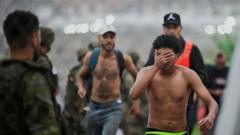
Many of those crossing the border from Morocco have been young, mainly men, although there are also women and children in the crowds and even babies.
Officials estimate at least 7,000 of those who crossed illegally into the territory in the last 24 hours are minors.
Usually, to try to enter Ceuta, migrants swim several kilometres from further up the coast. This time they appear to have been able to get close to the border fence itself with ease. At the start, some even walked along the rocks on the jetty and around the end of it, but most had to swim out and around to reach the beaches on the other side.
It's not clear where the Moroccan border guards were at this point and why the groups of migrants were not dispersed or stopped.

Many young men were seen swimming into Ceuta or crossing the land border
The sudden influx of people on Thursday followed several days with an increase in arrivals swimming into Ceuta. It appears that word of their success spread quickly.
The last time there was a surge in arrivals - though on nowhere near this scale - was in 2021. At that point, the Moroccan authorities allowed some 8,000 people to cross the border following a dispute with Madrid over the sovereignty of the Western Sahara.
That diplomatic dispute has flared again recently, after Prime Minister Pedro Sánchez travelled to Algeria which backs independence for the region.
Spain's interior ministry said it was working with Morocco to ensure the return of all who crossed illegally into its territory "as soon as possible".
Sánchez is set to visit Ceuta later on Friday.

Overnight into Friday, crossings continued as did clashes between migrants and police along the border, local media reported.
It is not yet clear what prompted this surge in illegal crossings from Morocco, or how hard the authorities there tried to prevent it. At one point, a Spanish official said the border was in total collapse.
Italy's prime minister was very quick to comment on events in Ceuta, calling the images from there "shocking" and writing on social media that such "uncontrolled immigration" was a security threat to Europe.
She said Italy would consider suspending the Schengen zone agreement with Spain on free movement, although it's unclear what that means in practice given that the two countries are not neighbours and undocumented migrants are unlikely to board flights.
In any case, the migrants who have arrived in Ceuta are now stuck there - not on the Spanish mainland.

Spain has now set up a large military presence at the border
Her comments echoed similar remarks made by foreign minister Antonio Tajani, who was accused of weaponising immigration for political ends by his Spanish counterpart, José Manuel Albares.
The Spanish foreign minister said such remarks were "improper" for "a partner and friendly country from which we expect European solidarity and not partisan demagoguery".
He also summoned the Italian ambassador to Madrid on Friday.
The Schengen Area is a system of open borders spanning 29 European countries that have officially abolished controls at their common borders.
Originally published by
BBC News
Aggregated from a public feed. Read the original at the source for the publisher's full presentation.
View original on bbc.co.ukContinue reading