Nato ‘will take all necessary measures’ to defend territory after Russian missile crashes in Poland – as it happened
Polish PM confirms the missile that crashed in Poland was a Russian Kh-101 cruise missile and says he is in touch with EU and US leaders Poland’s defence minister Władysław Kosiniak-Kamysz confirms it’s “most likely” it…

Closing summary

Jakub Krupa
And, on that note, we will be closing the blog for today.
-
Russia has been accused of violating Polish airspace after a missile exploded in a field in the east of the country, triggering Nato air defences (9:19).
-
The missile crashed in an uninhabited rural area, and on impact created a crater about 10 meter wide (9:42), but caused no casualties.
-
Poland’s prime minister Donald Tusk said the missile “looked like” a Russian Kh-101 cruise missile (10:23), a view confirmed by early military assessment (10:40), which Russia also used in strikes against Ukraine last night, which killed at least nine people.
-
But Tusk insisted that there was “no reason to think Poland was the intended target,” as investigators look into how it ended up within Polish and Nato airspace (12:25).
-
Nato said it was in contact with the Polish authorities, and stressed it would “take all necessary measures to defend Nato territory” (13:55).
-
The incident was widely condemned by top EU and European leaders (10:03, 11:51, 13:23, 16:25, 16:32).
If you have any tips, comments or suggestions, email me at jakub.krupa@theguardian.com.
I am also on Bluesky at @jakubkrupa.bsky.social and on X at @jakubkrupa.
Key events
Closing summary
'Russia's war is a threat to our collective European security,' Denmark's Frederiksen says
Germany's Merz condemns Russian attacks on Ukraine, 'reckless' missile incident in Poland as he warns Russia "willing to escalate"
Thousands of migrants try to overwhelm border controls, cross into Spain's Ceuta
New UK border rules left couple stuck in Kraków after living in UK for 80 years
Was Florentine friars’ fatigue-fighting elixir a precursor to Coca-Cola?
German chancellor choses pope’s AI encyclical over pacy potboiler as holiday read
Firefighters race to extinguish blazes across EU as fire weather breaks records
Spain ends national emergency amid progress in fight against wildfires
'We are on the right track,' French authorities say as thousands of evacuees return home after wildfires
Ukraine ready to offer 'all necessary assistance' to investigate Russian missile incident
Nato 'in close contact' with Poland over airspace violation, says 'will take all necessary measures' to defend territory
'Another unacceptable violation of EU airspace,' von der Leyen says
'Next 100 days may decide this war,' Poland's Tusk says, as he doubles down on pledge to support Ukraine
'No reason to think Poland was the intended target for this missile,' PM Tusk says
France's Macron condemns strikes on Ukraine, missile incident in Poland
Polish minister warns against Russian disinformation about missile incident
One of the most serious incidents in a Nato country since the start of Russia's full-scale aggression against Ukraine - snap analysis
Ukraine requests to join Polish investigation into missile crash, prosecutor says
'Most likely' it was a Russian Kh-101 cruise missile that crashed in Poland, defence minister says
'Looks like it was a Russian missile,' Poland's PM Tusk confirms
'Russia's aggression is a threat to the security of Europe as a whole,' EU's Costa says
Russia's war 'continues to endanger lives far beyond Ukraine,' Estonia's president warns
Aftermath of overnight Russian strikes on Ukraine - in pictures
A Russian cruise missile crossed into Poland, Ukraine's foreign minister says
Morning opening: At least eight killed in Russian attacks on Ukraine as Poland investigates airspace violation
'Russia's war is a threat to our collective European security,' Denmark's Frederiksen says
Danish prime minister Mette Frederiksen also joined in condemnations, saying:
“I strongly condemn the Russian attack killing civilians in Ukraine and the violation of Polish airspace. Russia’s war is a threat to our collective European security. Denmark stand by Ukraine and Poland. We must increase our support for Ukraine and the pressure on Russia”
Germany's Merz condemns Russian attacks on Ukraine, 'reckless' missile incident in Poland as he warns Russia "willing to escalate"
Back to Poland and Ukraine, German chancellor Friedrich Merz “strongly condemned” the Russian attacks on Ukraine, and a “reckless” missile incident in Poland.
In a statement, he said:
“We strongly condemn the massive Russian attacks on Ukraine. Many civilians had to lose their lives once again. And the strike in Poland also testifies to Russian recklessness and willingness to escalate. We stand unwaveringly by our partners.”
Thousands of migrants try to overwhelm border controls, cross into Spain's Ceuta
Migrants tried to force their entry into Spain’s North African enclave of Ceuta on Thursday, overwhelming police at the city’s breakwater, after swimming over from the Moroccan side, Reuters reported.
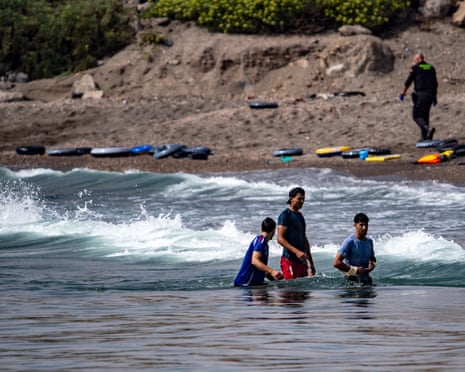
A Guardia Civil spokesperson said the migrants were “massively entering from the sea” through the Tarajal breakwater, but could not provide any estimates for the numbers.
State television TVE on Thursday reported that 2,000 to 3,000 youths had crossed, while state news agency EFE said some had scaled the border fences without swimming.
“The Government of Spain is fully committed to providing an immediate response to the situation in Ceuta,” prime minister Pedro Sánchez said in a post on X.
New UK border rules left couple stuck in Kraków after living in UK for 80 years

Lisa O’Carroll
Two Polish citizens who have lived in the UK for nearly 80 years after their parents fled the second world war have spoken of their terrifying experience after being told they did not have post-Brexit rights to return to the UK.

In May, while visiting Poland, they learned that although they had been welcomed as refugees after the war, they now needed special post-Brexit paperwork to return to their home in Bury.
Maria Krupa, 85, and her husband, Czesław, 92, who met in the UK and went on to marry and settle in Bury in Greater Manchester, were issued with “aliens’ registration cards” and have travelled extensively as adults without anyone asking them for their immigration status.
Czesław, who came from Lviv which was then part of Poland, and Maria, who left her home town in what is now Belarus as an infant, had travelled to Poland in May to meet surviving family members.
But Ryanair refused to allow them to board the flight for their return journey on the grounds that they had neither proof of the right to live in the UK nor the new electronic travel authorisation (ETA) now required for foreign tourists entering the UK.
“It was a big shock,” said Maria. “We were very very disappointed and a bit upset because my husband takes a lot of medicine because of a stroke to his spinal cord.”
Was Florentine friars’ fatigue-fighting elixir a precursor to Coca-Cola?

Angela Giuffrida
in Rome
An Italian friar has unearthed a document from the pharmacy archives of an ancient convent in Florence describing a medicinal potion made from Bolivian coca leaves and kola nuts, prompting suggestions it could have been a precursor to the famous US soft drink, Coca-Cola.
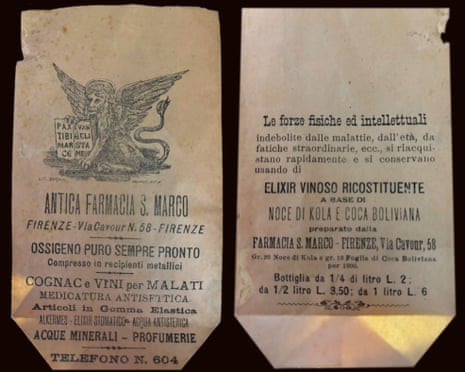
Father Manuel Russo, rector of the San Marco convent, said he stumbled across the yellowed document, a sort-of promotional flyer, while sorting out the archives.
The flyer details the recipe for an elixir vinoso ricostituente, or restorative wine elixir, made with 10g of Bolivian coca leaves and 30g of kola nut, blended with wine, which the friars who concocted it promoted as a tonic to be used to recuperate the body and mind from fatigue caused by illness and ageing.
The document was not dated, but it is believed to have been produced around the mid-19th century, when the friars plied a brisk trade in Bolivian coca leaves imported to Italy by missionaries, long before they were globally banned in 1961 for containing the natural alkaloid used to make cocaine.
The recipe was similar to the one used by the American pharmacist, John Pemberton, who in 1886 created a sweet syrup by mixing coca leaf extract and kola nuts. Local alcohol laws prevented him from using wine and so he combined the ingredients with carbonated water. Pemberton’s tonic eventually became Coca-Cola.
After learning of Russo’s discovery, some local news outlets pondered whether the soft drink’s origins were, in fact, in Florence and not the US.
German chancellor choses pope’s AI encyclical over pacy potboiler as holiday read

Deborah Cole
in Berlin
Summer is normally thought of as the time for pacy potboilers and brain-soothing page-turners – airport reads that wind up sandy and sunscreen-stained. Not so for Friedrich Merz’s holiday reading list.
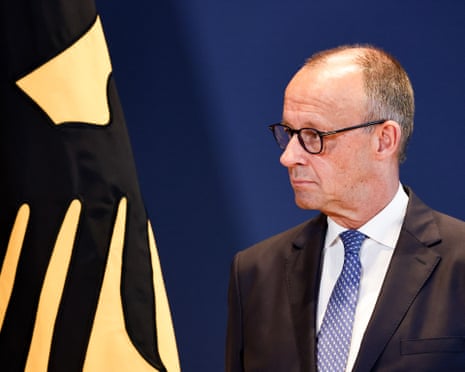
Germany’s embattled chancellor, who has faced one rough patch after another since taking office 14 months ago, seems to be seeking spiritual guidance this year while putting his feet up.
According to the conservative broadsheet Frankfurter Allgemeine Zeitung, the Christian Democratic Union leader is taking Pope Leo’s encyclical on artificial intelligence, Magnifica humanitas (Magnificent humanity), on his break.
Introduced by the Guardian in May as “the first major text on safeguarding humankind of his papacy”, the encyclical makes the case for the “most rigorous” ethical constraints on the march of technology, calling AI the biggest threat to humanity.
One of the world’s 1.4 billion Roman Catholics, Merz tends to be private about matters of belief, so his beach reading speaks volumes.
The historically unpopular 70-year-old politician has described AI as a challenge and a chance for Europe’s top economy after seven years of stagnation, just as he has demanded streamlined EU rules to prevent red tape from snuffing out its potential.
Firefighters race to extinguish blazes across EU as fire weather breaks records

Ajit Niranjan
Europe environment correspondent
Fire weather in the EU has broken records for severity for this time of year, new data shows, as firefighters race to extinguish blazes across the Mediterranean.
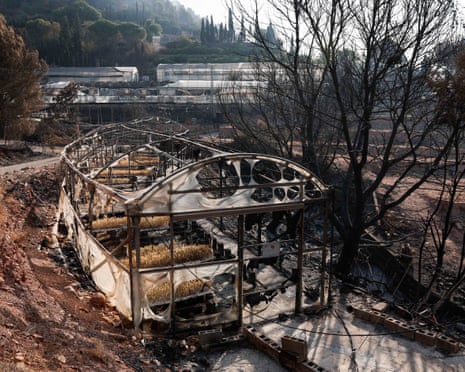
Inflamed by carbon pollution, the hot, dry and windy weather across the EU since the start of the year has been 43% more severe than the end-of-July average over the last two decades, data from the European Forest Fire Information Service (Effis) shows.
Three firefighters died in Greece on Tuesday, officials said, while firefighters in France and Spain made overnight progress tackling monster blazes that have burned dangerously close to large cities.
The figures, which were published on Thursday but may be revised further, showed that so far this year 435,000 hectares (1,075,000 acres) have burned, roughly triple the recent historical average. The devastation is the result of 1,400 fires, more than double the average.
Spain ends national emergency amid progress in fight against wildfires
In Spain, prime minister Pedro Sánchez on Thursday lifted a state of emergency over wildfires threatening areas near Madrid, after the prefect’s office said they had stopped expanding with “almost no flames left,” AFP reported.
By Thursday, only a thousand evacuees remained in the region, after thousands returned home on Wednesday.
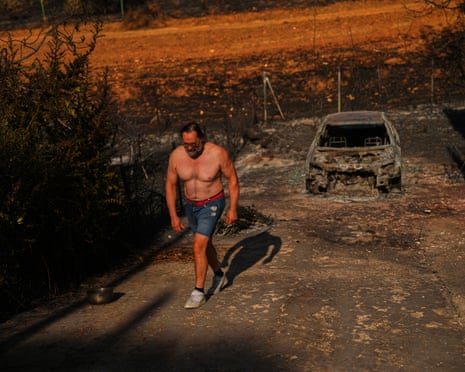
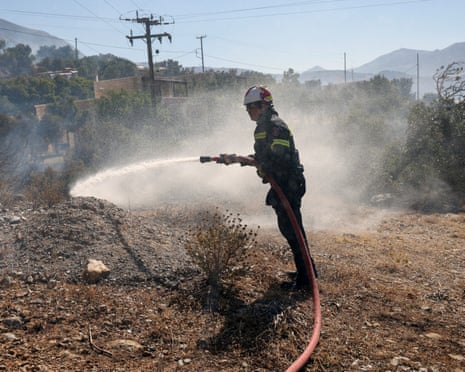
Elsewhere in Europe, thousands of people were evacuated late on Wednesday as fires threatened a tourist resort on the Greek island of Crete and continued to rage on Thursday, fanned by violent winds, authorities said.
'We are on the right track,' French authorities say as thousands of evacuees return home after wildfires
France has allowed 84,000 evacuees to return home after a massive wildfire forced them out, AP reported.
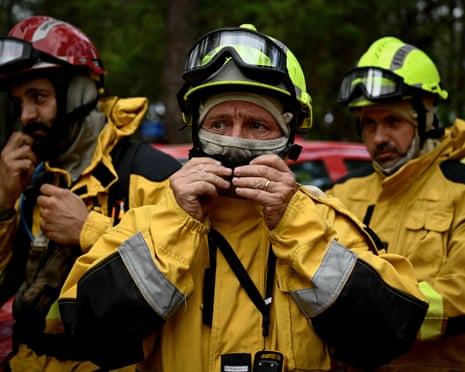
This marks progress in the fight against the flames, which have burned an area four times the size of Paris.
“We’re on the right track,” said Sophie Brocas, prefect of Bordeaux’s Gironde region who gave the go-ahead for nearly two-thirds of the 224,000 evacuees to go home. They include 60,000 people allowed back to three Bordeaux suburbs on Tuesday.
But returnees were told to keep phones on and pack bags in case they have to be evacuated again, AP noted.
Jakub Krupa
Let’s take a quick look at other news from around Europe.
Poland’s foreign minister Radosław Sikorski spoke to BBC’s “World at One” this afternoon, saying it’s not clear if the missile incident was deliberate or not.
“We do not know whether this was a malfunction or deliberate, but at this stage we have to keep options open.”
He said allies needed to “stick to our plan of assistance to Ukraine,” with the particular focus on air defence missiles.
He also said:
“The Russians may be counting that they might break Ukraine’s resistance by attacks on heating and, in power generation. They have destroyed 80% of Ukraine’s electricity generating capacity, which of course affects not only civilians but also, production capabilities in the defence sector and so on.
So Putin seems to be desperate and throwing his all at Ukraine. We have had another horrible night of attacks on Kyiv and on Western Ukraine.”
Ukraine ready to offer 'all necessary assistance' to investigate Russian missile incident
Ukraine’s foreign minister Andrii Sybiha stressed Ukraine’s “full solidarity with Poland,” and Kyiv’s offer to “provide all the necessary assistance in investigating the incident.”
“We agreed that strengthening Ukraine’s air shield should be an urgent priority for the entire Euro-Atlantic community,” he said.
He also added:
“I believe that today’s missile incursion also serves as a stark reminder of the horrific reality facing both our countries: it is time to focus on countering acute threats in the present rather than divisive debates about the past.”
Originally published by
Guardian World
Aggregated from a public feed. Read the original at the source for the publisher's full presentation.
View original on theguardian.comContinue reading