Thousands of migrants enter tiny Spanish enclave of Ceuta from Morocco
Territory’s president calls for help from Spanish government as crowds of people arrive by sea or on foot The leader of Spain’s north African enclave of Ceuta has called on the government in Madrid to declare a national…
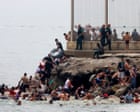
The leader of Spain’s north African enclave of Ceuta has called on the government in Madrid to declare a national emergency after thousands of migrants swam and waded into the tiny territory from neighbouring Morocco in a matter of hours.
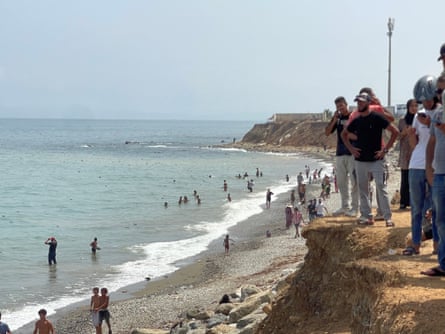
Videos shot at Tarajal beach on Thursday showed crowds of people walking around the breakwaters and running on the beach and roads.
Most appeared to be young men, but there were also families with women and children. “Viva España!” some shouted to a freelance photographer working for the Associated Press, who was filming the scene.
A Guardia Civil spokesperson said the migrants were “massively entering from the sea” through the Tarajal breakwater but could not provide any estimate of the numbers.
Spain’s national broadcaster, TVE, reported that between 2,000 and 3,000 people had crossed into Ceuta, while the state news agency, Efe, said some had entered the territory by scaling the high border fence.
Juan Jesús Vivas, the president of Ceuta, demanded the deployment of additional police and soldiers “to guarantee the inviolability of the frontier” and citizens’ safety.
Vivas had warned on Wednesday that migrant reception centres were overwhelmed, with hundreds of people sleeping on the streets.
He said Ceuta needed “more resources, more infrastructure, more regulation and effective coordination between all the administrations”.
“We’re not looking for privileges; we’re looking for a fair and responsible solution in line with our reality,” he added.
Although the central government announced that Fernando Grande-Marlaska, Spain’s interior minister, would travel to Ceuta on Friday as a matter of urgency, it said a national emergency could not be declared over a migration issue.
It added that such an emergency could be declared only over dire meteorological events – such as the current wildfires – or in the face of a volcanic or nuclear threat.
Pedro Sánchez, Spain’s prime minister, said his government would provide “an immediate response” to the situation in Ceuta, which echoes the border crisis in 2021 when more than 8,000 people arrived in just two days.
“We’re mobilising all necessary resources, working with Moroccan and international authorities, and preparing the necessary measures to restore normalcy as soon as possible,” he said in a post on X.
“I just conveyed this to President Vivas. This is the moment to build solutions, with responsibility and cooperation.”
This month Spain’s supreme court ruled that migrants intercepted at sea while attempting to reach Ceuta – or Spain’s other north African territory of Melilla – could not be summarily returned under the enclaves’ special border rejection regime.
The Guardia Civil spokesperson told Reuters: “It has been a slow trickle since the supreme Court’s ruling, but today has been an explosion.”
Alberto Núñez Feijóo, the leader of the conservative opposition People’s party, to which Vivas belongs, said the situation was desperate. “The government can’t look the other way,” he added, “because we are facing a national security crisis.”
Santiago Abascal, who leads the far-right Vox party, described the incident as an “invasion” and said those crossing into Ceuta were not fleeing war or poverty but had been summoned by Sánchez’s government to ensure he could remain in power.
Moroccan government sources attributed the surge to “criminal organisations” and insisted that the country’s cooperation with Spain remained “exemplary”.
The mass crossing into Ceuta in May 2021 came amid heightened tensions between Madrid and Rabat over Spain’s decision to allow a Western Sahara independence leader to be treated for Covid-19 in Spain. Speaking at the time, Sánchez hinted at a link between the sudden relaxing of border controls and the diplomatic tensions.
“As the president of Spain, I believe firmly that Morocco is a partner country, it’s a country that is a friend of Spain and it should continue this way,” he said. “To be effective, this cooperation needs to always be based on respect. Respect for mutual borders.”
Ceuta and Melilla make up the EU’s only land border with Africa. Both cities periodically experience surges in attempted crossings by migrants seeking to reach Europe.
Originally published by
The Guardian
Aggregated from a public feed. Read the original at the source for the publisher's full presentation.
View original on theguardian.comContinue reading